The United States Constitution opens with one of the most famous sentences in all of history — and it closes that sentence with some of the most beautiful words ever written into law: and secure the blessings of liberty to ourselves and our posterity. In a single breath, the framers promised freedom not only to their own generation, but to every generation that would follow — including ours.
But what do these words actually mean? Why did the founders choose “secure” instead of “give,” what are the “blessings” of liberty, and who exactly is “our posterity”? These are questions students, teachers, pastors, and everyday Americans have pondered for more than two centuries.
In this guide, we will walk through the phrase slowly and carefully — its history, its grammar, its faith dimension, and what it asks of each of us today. Whether you are studying the Constitution, preparing a lesson, or simply curious about the words that shaped a nation, you will find clear answers here.
So let us begin where the founders began: with fifty-two words that changed the world, and a promise made across time itself.
What Does “And Secure the Blessings of Liberty” Mean?
Strip the phrase to its essentials and each word carries deliberate weight. “Secure” is an action verb — it means to protect, to guarantee, to make safe against loss. The framers did not say “hope for” the blessings of liberty or “wish for” them. They chose a word of determination: freedom must be held firmly, or it can slip away.
“Blessings” speaks of the good gifts that freedom produces — the rich harvest that grows in the soil of liberty. And “liberty” means freedom itself: freedom from tyranny, from unjust rule, and from anyone who would control how you live, speak, worship, or think. Together, the words “and secure the blessings of liberty to ourselves and our posterity” form the climax of the entire Preamble.
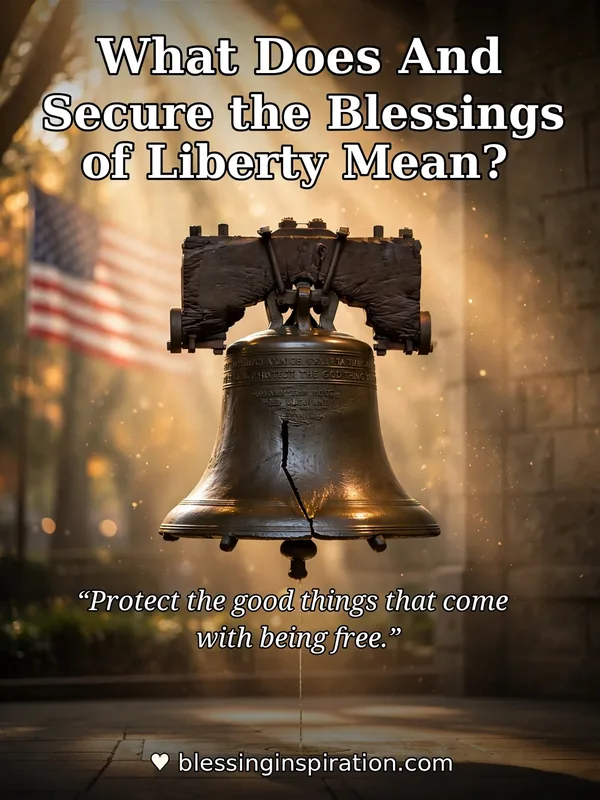
- “Protect the good things that come with being free.”
- “Make sure freedom — and everything good it brings — is kept safe.”
- “Guard liberty so its benefits can never be taken away.”
- “Hold freedom firmly, for ourselves and for all who come after us.”
- “Treat liberty as a treasure to be defended, not a gift to be spent.”
- “Keep the blessings of freedom safe across every generation.”
The Full Preamble in Context
To understand the closing clause, it helps to see the entire sentence it belongs to. The Preamble of the Constitution is a single sentence of fifty-two words, and it reads:
“We the People of the United States, in Order to form a more perfect Union, establish Justice, insure domestic Tranquility, provide for the common defence, promote the general Welfare, and secure the Blessings of Liberty to ourselves and our Posterity, do ordain and establish this Constitution for the United States of America.”
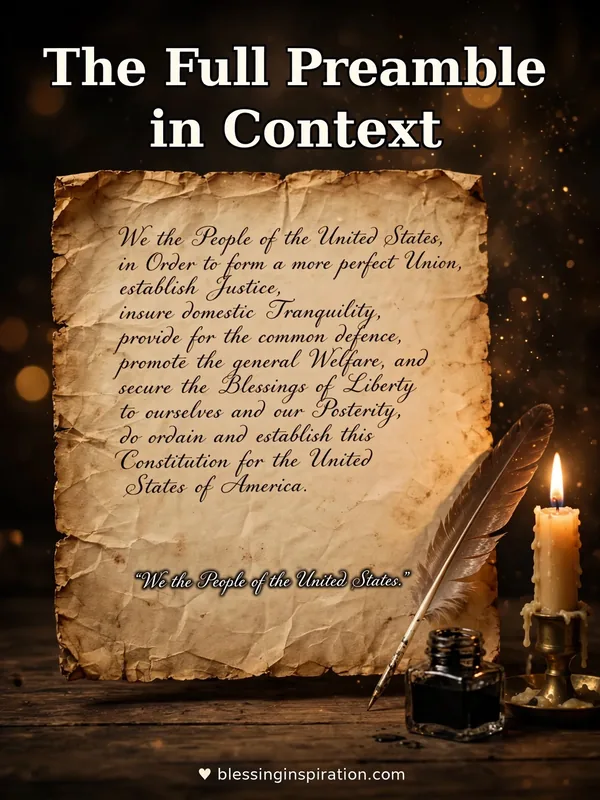
Notice the architecture. The sentence begins with “We the People” — the source of all authority — and moves through six great purposes: union, justice, peace, defense, welfare, and liberty. The posterity clause arrives at the very climax, attached to the final and weightiest purpose, and then the sentence resolves with “do ordain and establish” — the act of creation itself.
Placing liberty last was no accident. In the rhetoric of the founders’ era, the final position carried the greatest emphasis. Everything the Constitution creates — the Congress, the courts, the rights it protects — serves this ultimate end: that freedom, with all its blessings, endures for ourselves and for our posterity.
Why the Founders Wrote These Words
Picture the summer of 1787. In Philadelphia, fifty-five delegates gathered in sweltering heat to repair a young nation in trouble. The Articles of Confederation had failed: the government could not collect taxes, pay its debts, or raise an army. Then Shays’ Rebellion shook Massachusetts, and leaders everywhere wondered whether the liberty won in the Revolution would dissolve into chaos.
The delegates carried fresh memories of tyranny — a king who taxed them without representation and sent soldiers to enforce his will. They had risked everything to break free, and the thought of losing that freedom was unbearable. When they wrote about securing the blessings of liberty to ourselves and our posterity, they were answering the deepest fear of their generation.
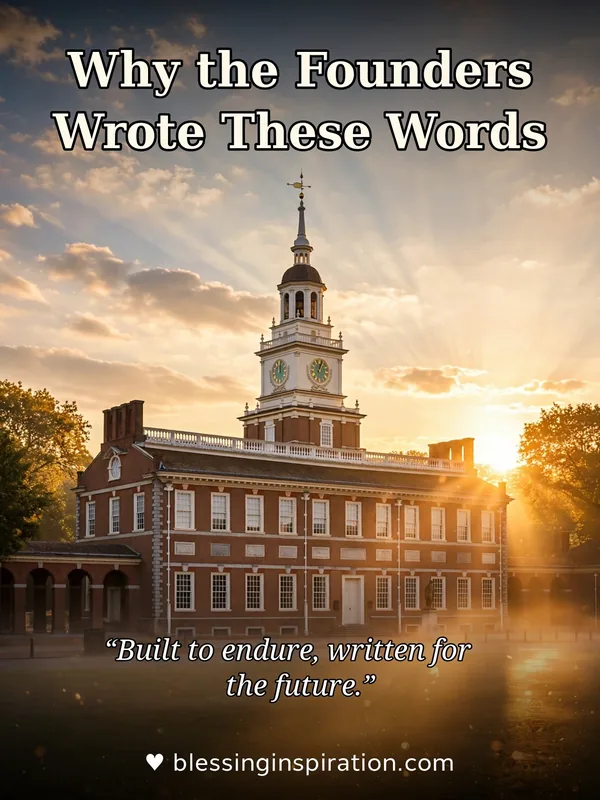
- They had just won freedom at terrible cost — and they were determined not to lose it to disorder, division, or a new tyrant.
- They wanted the Constitution to last — naming posterity announced the ambition out loud: this government was built to endure.
- They believed the unborn have interests worth protecting — even those who cannot vote or speak deserve a future of freedom.
- They had studied the fall of ancient republics — and knew that liberty, once lost, is terribly hard to regain.
- They saw themselves as trustees, not owners — each generation holds freedom in trust and must pass it on intact.
- They wanted to bind the future to the promise — so that no generation could claim liberty was only meant for 1787.
Read More: Secure the Blessings of Liberty to Ourselves and Our Posterity: Meaning
What “Ourselves and Our Posterity” Means
The little word “and” in “to ourselves and our Posterity” joins two distinct promises. “Ourselves” means the living generation — the framers, the citizens of 1787, and by extension every American alive at any given moment, including us. “Our posterity” means everyone who comes after: our children, our grandchildren, and all future generations of Americans.
The pairing is deliberate. The founders could have written only “to ourselves” — securing liberty for their own time and letting the future fend for itself. Instead they named both, insisting that liberty must be enjoyed now and preserved for later. This is why they wrote “and secure the blessings of liberty to ourselves and our posterity” as one unbroken promise covering the present and the future together.

There is also a quiet humility in the phrase. By writing “our posterity,” the founders admitted they were not the final chapter of the American story. They saw themselves as the opening pages — important, but not complete. The Constitution was not a monument to their achievement but a trust handed forward.
In plain English, the clause means: “We are protecting freedom for us, and we are protecting it for everyone who will come after us.” It is both a comfort — liberty was meant to last — and a commission — each generation must make sure it does.
The Blessings of Liberty: A Faith Perspective
For people of faith, the phrase “blessings of liberty” carries an extra layer of meaning. The founders themselves saw freedom as something heaven smiles upon. Scripture declares, “where the Spirit of the Lord is, there is liberty,” and the Liberty Bell itself bears the ancient command to “proclaim liberty throughout all the land.”
From a faith perspective, liberty is not merely a political arrangement — it is a sacred trust. The call to “and secure the blessings of liberty to ourselves and our posterity” resonates deeply with the biblical view of stewardship: we are caretakers of gifts we did not create, accountable for passing them on. Freedom allows us to worship according to conscience, to raise our children in truth, to speak honestly, and to love our neighbors openly.
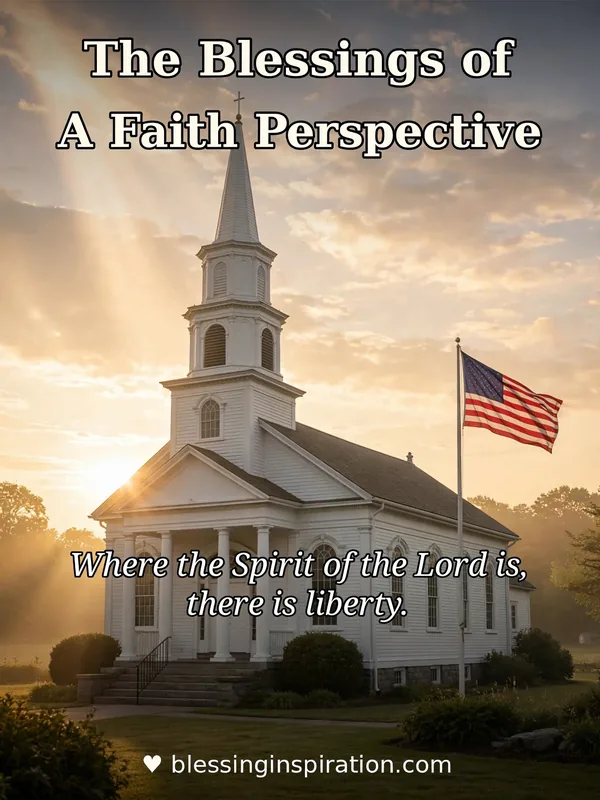
- Freedom to worship — to gather, pray, and follow conscience without fear.
- Freedom to speak truth — to share convictions openly and honestly.
- Freedom to raise families in faith — to pass godly values to our children.
- Freedom to serve others — to love our neighbors through charity and kindness.
- Freedom to work and provide — to use our gifts and keep the fruits of our labor.
- Freedom to rest and reflect — to observe days of worship and renewal in peace.
- The blessing of gratitude itself — recognizing freedom as a gift makes every day richer.
How This Phrase Applies to Us Today
The promise to secure the blessings of liberty to ourselves and our posterity was not finished in 1787 — it was started. Every generation since has been invited to take up the work, and ours is no exception. Securing liberty today looks surprisingly ordinary, and that is exactly the point.
It looks like voting in every election, teaching children how their country works, caring for shared spaces, and defending one another’s freedoms — not just our own. To live out “and secure the blessings of liberty to ourselves and our posterity” today is to accept the same trustee role the founders claimed in 1787. The Preamble asks each of us a simple, searching question: what will you secure for those who come next?

- Vote in every election — including local ones that shape your children’s future.
- Teach the next generation — explain the Constitution, the Bill of Rights, and why they matter.
- Defend others’ freedoms — protecting speech you disagree with keeps liberty strong for all.
- Serve your community — juries, volunteering, and honest citizenship are posterity work.
- Care for shared blessings — parks, libraries, and clean water are inheritances to maintain.
- Pass on your faith and values — the deepest inheritance is spiritual, not material.
- Stay informed and engaged — a free people must pay attention to remain free.
Read More: Secure the Blessings of Liberty Meaning
Famous Quotes About Liberty and Posterity
The founders and their heirs returned to the theme of liberty and posterity again and again. These brief, famous lines show how seriously they took the duty to the future — and each one echoes the promise to secure the blessings of liberty to ourselves and our posterity.

- “I must study politics and war that my sons may have liberty to study mathematics and philosophy.” — John Adams, 1780
- “The earth belongs in usufruct to the living.” — Thomas Jefferson, 1789
- “The preservation of the sacred fire of liberty… is deeply, perhaps as finally staked, on the experiment entrusted to the hands of the American people.” — George Washington, 1789
- “Those who would give up essential Liberty, to purchase a little temporary Safety, deserve neither Liberty nor Safety.” — Benjamin Franklin, 1755
- “Give me liberty, or give me death!” — Patrick Henry, 1775
- “The God who gave us life gave us liberty at the same time.” — Thomas Jefferson, 1774
- “The price of liberty is eternal vigilance.” — often attributed to Thomas Jefferson
Reflections to Share and Remember
Some truths are worth carrying with you long after you finish reading. These short reflections capture the heart of the promise in “and secure the blessings of liberty to ourselves and our posterity” — save them, share them, and let them remind you of the trust every generation holds.

- Liberty is inherited, not owned — we hold it in trust for those who come next.
- You are someone’s posterity: the founders were thinking, in some measure, of you.
- You are also someone’s ancestor: your choices are writing the next lines of the story.
- Freedom kept only for today is freedom half-kept.
- The cheapest time to secure liberty for the future is right now.
- Gratitude for freedom is the first step toward guarding it.
- Every generation must answer the same question: what will I secure for those who come next?
Final Thoughts
Every generation stands at the same crossroads the framers faced: enjoy liberty now, or secure it for later? The genius of the Preamble is that it refuses the choice. “To ourselves and our Posterity” — both, always, together. That is the enduring meaning of the promise to secure the blessings of liberty to ourselves and our posterity.
If you would like to read the founding words in their original context, explore the Preamble page at the National Constitution Center, which presents the full text alongside scholarly interpretation of each clause.
So close the page, look around at the life those words made possible, and ask the question every generation must answer: what will I secure for those who come next? The founders ran the first leg of the race and passed the baton cleanly. Now it is our turn to run — and to pass it on.

Blessinginspiration is a trusted source of messages, wishes, and quotes, managed by Emily, an SEO content writer with 2 years of experience, creating meaningful content that helps people express every emotion with the right words.